
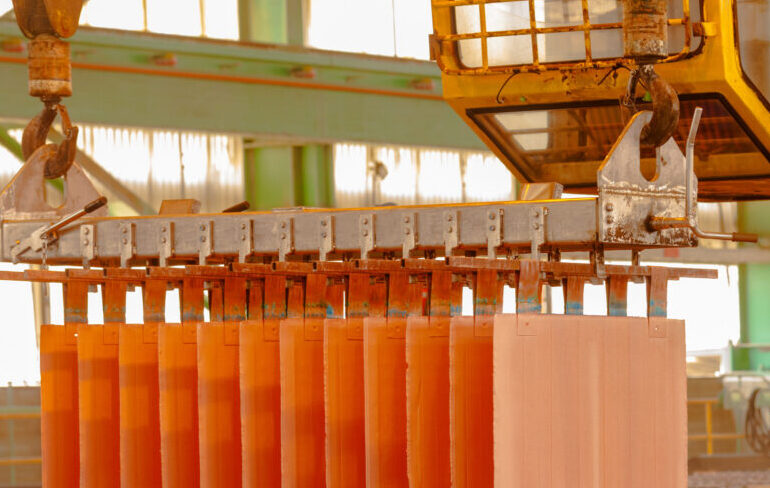
A record concentration of copper in US warehouses is distorting the picture of global supply, leaving manufacturers in other markets competing for increasingly expensive metal even as headline inventory figures suggest the world has enough copper.
Nearly 70% of visible exchange copper stocks were held in the United States in October, according to a study by GEM Mining Consulting. Global inventories across the London Metal Exchange (LME), COMEX and Shanghai Futures Exchange (SHFE) reached 1.04 million tonnes, an 83% increase from a year earlier. But the location of those stocks, rather than their combined volume, is becoming the critical issue for buyers.
The market’s regional divide was reinforced by developments on November 2. London copper recovered some ground, with three-month LME copper trading at $14,240 a tonne in official open-outcry activity, up 0.6%. Yet traders remained cautious ahead of the November 3 US midterm elections, while fresh deliveries into US warehouses highlighted how much metal remains concentrated on the American side of the market.
The supply imbalance is also reflected in sharply different forecasts. The International Copper Study Group (ICSG) expects a refined copper surplus of 104,000 tonnes in 2026. Goldman Sachs, however, estimates a deficit of approximately 950,000 tonnes in markets outside the United States and forecasts that LME copper could reach $14,700 a tonne by the end of 2026.
US warehouses hold an unprecedented share of exchange stocks
GEM’s analysis by Patricio Faúndez, based on data from Chile’s Copper Commission (Cochilco), found that COMEX warehouses held 718,000 tonnes of copper in October. That represented 69% of visible stocks across COMEX, the LME and SHFE.
The scale of the shift is striking. Between 2015 and 2024, COMEX accounted for an average of just 16% of exchange inventories, with its share never exceeding 36%. The October stockpile was roughly twice the exchange’s previous record in Cochilco’s historical series dating back to 1990.
Combined LME and SHFE inventories stood at 319,000 tonnes, 11% below their 2015–2024 average. The figure included nearly 130,000 tonnes in LME warehouses in New Orleans and Baltimore, according to press reports cited by GEM. Excluding those holdings leaves approximately 190,000 tonnes of visible exchange copper outside the United States.
The concentration began accelerating after Washington launched a Section 232 investigation into copper imports in February 2025. Traders moved metal into the country in anticipation of possible tariffs, creating a substantial premium for US-bound shipments.
Between February and July 2025, COMEX copper traded at an average premium of about $1,120 a tonne over LME prices. The monthly spread reached $2,230 in July.
The premium collapsed after the Trump administration announced on July 30, 2025, that refined copper cathodes would be excluded from its 50% import tariff. But the movement of metal into the United States continued.
Faúndez found that 77% of the 633,000 tonnes added to COMEX inventories since February 2025 arrived after the tariff announcement. From August 2025 through September 2026, the COMEX-LME spread averaged just $156 a tonne, close to its 2024 average of $151.
That persistence suggests the flow of copper is no longer driven solely by immediate arbitrage opportunities. The possibility of future duties has encouraged traders to keep metal in the United States rather than risk the cost and uncertainty of moving it back into international markets.
The latest exchange data underline the same problem. LME-registered inventories rose to 293,775 tonnes on November 2, their highest level since mid-July, after 20,500 tonnes were delivered into warehouses in New Orleans. Morgan Stanley analyst Amy Gower said the market was treating US-held stocks as largely unavailable, noting that deliveries into American warehouses did not affect the market in the same way as metal delivered in Europe or Asia.
China premiums, Project Vault and Chile’s output warning add pressure
Physical-market indicators in China point to tightening availability despite the rise in global exchange inventories. The Yangshan copper import premium reached $200 a tonne at the end of October, close to its highest level in more than a decade, according to Reuters.
Shanghai Metals Market reported that Yangshan warrant premiums averaged $193 a tonne during October 26–29, while bill-of-lading premiums averaged $180. On October 30, the warrant premium remained at $200. The figures indicate that Chinese buyers were paying substantially more to secure imported copper, even as futures-market activity remained cautious.
Goldman Sachs has raised its price outlook in response to the tightening supply picture. The bank now expects copper to average $15,400 a tonne in 2027, while forecasting a deficit of 220,000 tonnes outside the United States that year. Its 2026 estimate for the ex-US deficit is 950,000 tonnes.
The contrasting ICSG and Goldman Sachs projections reflect different assumptions about the geographical distribution of inventories and the availability of metal to consumers. A global surplus does not necessarily translate into accessible supply in China, Europe or other importing markets if a large share is held in US warehouses.
Washington’s strategic stockpiling programme is adding another dimension. On October 16, Swiss commodities trader Mercuria and the Democratic Republic of Congo’s state mining company Gecamines confirmed that 12,000 tonnes of Congolese copper had entered Project Vault, the US government’s strategic reserve for critical minerals.
The shipment was described as an initial delivery. Gecamines and Mercuria are targeting a broader supply arrangement involving at least 100,000 tonnes of copper for the United States. Project Vault, announced in February, is designed as a $12 billion public-private initiative, combining private-sector funding with a $10 billion loan from the US Export-Import Bank.
The delivery demonstrates how US policy is influencing physical trade flows beyond conventional warehouse accumulation. Copper that might otherwise have entered the international market is now being directed into a strategic stockpile intended to support American manufacturers during supply disruptions.
Supply concerns are also emerging in Chile, the world’s largest copper producer. Cochilco sharply reduced its forecast for Chilean copper production in 2026 and projected a more modest recovery in 2027 than previously expected. The downgrade adds to concerns about mine supply at a time when the market is already struggling with regional availability.
The Democratic Republic of Congo and Zambia face additional risks from electricity shortages linked to El Niño-related drought conditions, according to BMI, a unit of Fitch Solutions. Any disruption to power supply could affect mining and processing operations in two of Africa’s major copper-producing countries.
The DRC is also tightening oversight of artisanal mining. Authorities have moved against unauthorized operations, including the suspension of an official responsible for supervising the sector, following reports of arrests involving hundreds of Chinese workers. These developments add regulatory uncertainty, although they do not by themselves establish an immediate reduction in national copper output.
The next major policy trigger remains Washington’s decision on potential tariffs on refined copper. A July 2025 presidential proclamation directed the Commerce Department to provide an update by June 30, 2026, allowing the administration to consider a phased duty of 15% from January 2027 and 30% from January 2028. The proposal has not been confirmed as an implemented tariff.
The administration has already imposed separate Section 232 duties on specified copper articles and derivatives during 2026. But the proposed duties on refined copper cathodes remain a distinct issue. Reuters reported in September that the White House had delayed a decision amid concerns that higher copper costs could increase expenses for manufacturers and consumers ahead of the US midterm elections.
If the proposed refined-copper duties proceed, traders may have further reason to keep inventories in the United States, potentially widening the gap between American and international prices. If the plan is abandoned, some metal could eventually return to overseas markets, easing pressure on buyers outside the United States and weakening the COMEX premium.
For now, the copper market is being shaped not simply by how much metal exists, but by where it is stored, who can access it and how trade policy influences its movement. The growing US stockpile is making global inventory totals a less reliable guide to the supply available to manufacturers elsewhere.