
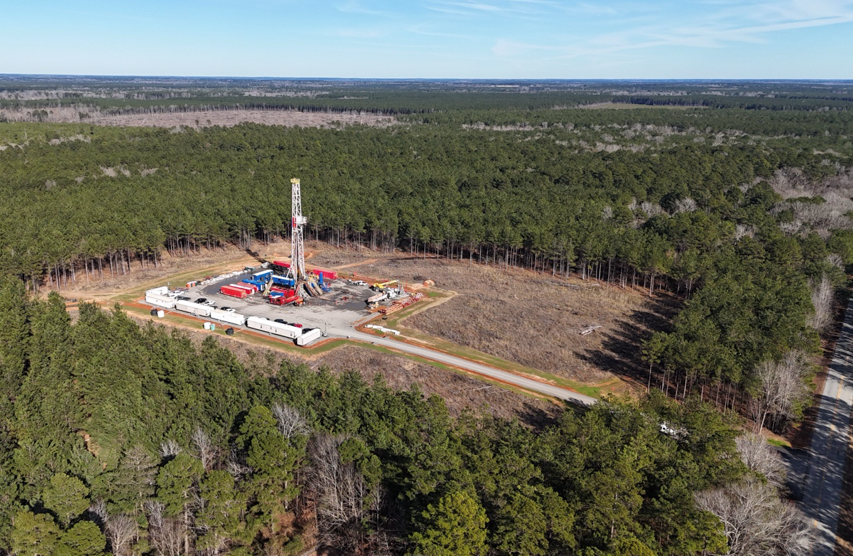
Standard Lithium and its partner Equinor aim to make a final investment decision by the end of this year on the South West Arkansas (SWA) project, a $1.45 billion venture that would be the first large-scale lithium producer in the Smackover Formation, according to the company. Construction would begin in early 2027 and production in 2029, subject to the decision and financing.
The project matters beyond its own economics. Washington is trying to cut its reliance on imported lithium, and the Smackover, a geological formation stretching from central Texas to the Florida panhandle, is one of the few U.S. sources whose brines carry lithium at concentrations comparable to those in South America. Whether SWA reaches production will indicate how quickly the U.S. can build a domestic supply from oilfield brines.
What the Project Is, and What the Numbers Say
Standard, based in Vancouver, owns 55% of the Smackover Lithium joint venture and operates it. Equinor, the Norwegian oil producer, holds 45%. The first stage is designed to produce 22,500 tonnes a year of battery-grade lithium carbonate over a modeled 20-year life, using direct lithium extraction (DLE), a process that pulls lithium from underground brine without the evaporation ponds used in conventional operations.
A definitive feasibility study released in September 2025 put the project’s after-tax net present value at $1.28 billion, with an internal rate of return of 18.2%. Those figures rest on an 8% discount rate and a long-term lithium carbonate price of $22,400 per tonne. The study estimates average cash operating costs at $4,516 per tonne and all-in sustaining costs at $5,924, excluding the initial construction bill. The capital estimate includes a 12.3% contingency.
Those are company-commissioned projections, and the returns depend heavily on the price assumption. Against the study’s price, the implied gap over all-in sustaining costs is about $16,500 per tonne, but the report does not show how returns would hold at lower prices. Standard Vice President of Government Affairs Jesse Edmondson told The Northern Miner the project can be economic “at current prices,” without specifying a figure.
Offtake and Financing: Progress, Not Commitments
Standard has contracts covering up to 20,000 tonnes a year, about 89% of planned output. These include an 8,000-tonne annual agreement with LG Energy Solution and a 10-year deal with trader Trafigura, expanded in September to as much as 12,000 tonnes. The Trafigura increase is optional for the joint venture. Counting it, coverage exceeds the partners’ 80% target.
On government support, the U.S. Department of Energy finalized a $225 million grant for construction in January 2025 and completed its environmental review in May with a finding of no significant impact. SWA has also been listed on the federal FAST-41 permitting dashboard.
Debt is less settled. In December 2025, the joint venture reported indications of interest for more than $1 billion in project financing from export credit agencies, including the Export-Import Bank of the United States and Export Finance Norway. These were not commitments. Edmondson said technical due diligence is “essentially done” and the remaining work is finalizing term sheets and assembling the equity portion, which the company has not detailed.
The Technology Question
The central unproven element is DLE at commercial scale. Standard says its demonstration plant near El Dorado, Arkansas, operating since 2020, has processed more than 160 million liters of brine. Element 3 said in February it began producing lithium carbonate at a 3,000-tonne-a-year facility in Midland, Texas, roughly one-seventh of SWA’s first-stage capacity.
Cameron Hughes, a lithium analyst at CRU in London, called DLE “still a fairly novel technology” and said it carries risk. He also noted that oil majors entering the region bring capital and subsurface expertise. ExxonMobil, Chevron and Occidental Petroleum are among those drawn to the Smackover. BMO Capital Markets analyst Raj Ray said Standard is well placed to be an early mover and that Equinor’s subsurface experience should complement the projects.
Standard’s second asset, Franklin in Texas, is earlier stage. A preliminary economic assessment filed Oct. 20 outlines production of up to 70,000 tonnes of lithium carbonate equivalent a year over 20 years, averaging about 65,000, with output possible in the early 2030s. Preliminary assessments carry lower confidence than feasibility studies. Edmondson said the company sees a path to at least 100,000 tonnes a year across its portfolio within a decade, and potentially 150,000.
What to Watch
The decisive milestone is the signing of binding debt terms and the equity structure, which will determine whether the investment decision holds to its year-end target. After that, the commissioning performance of SWA’s first stage, expected in 2029, will show whether DLE can deliver at 22,500 tonnes a year. Until then, the project’s returns, the offtake volumes and the regional growth Standard projects remain assumptions rather than results.