Lithium: Global Supply, Battery Uses and Processing
MINERAL PROFILE / GLOBAL RESOURCE HUB
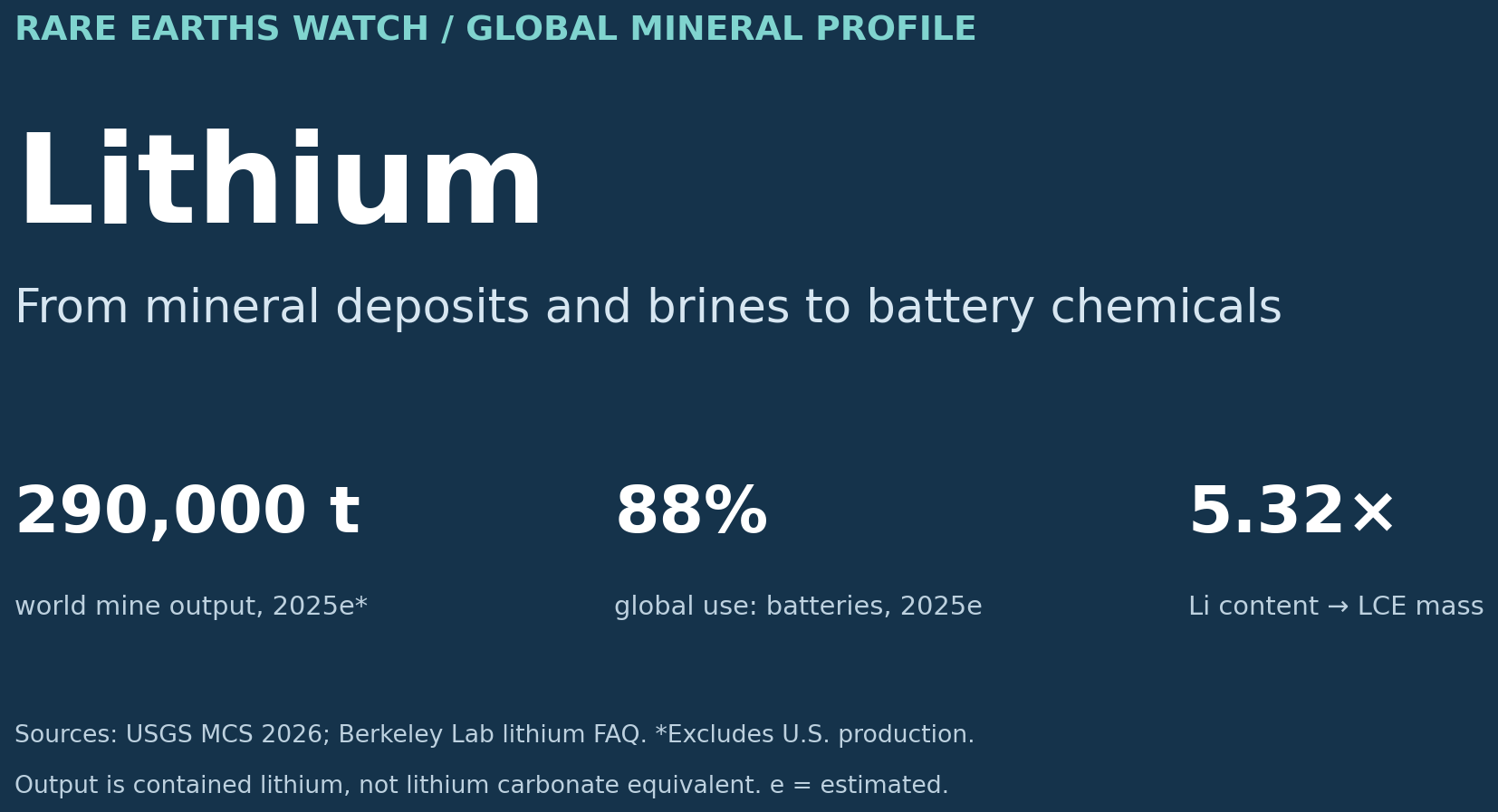
Lithium connects mines and brines to batteries, but geology, chemical processing and product quality determine which resources can become dependable supply for manufacturers around the world.
Cover graphic: original Rare Earths Watch design; USGS MCS 2026 and Berkeley Lab.
Uses · Production · Processing routes · Units explained · Global coverage · Sources and updates
Why lithium matters
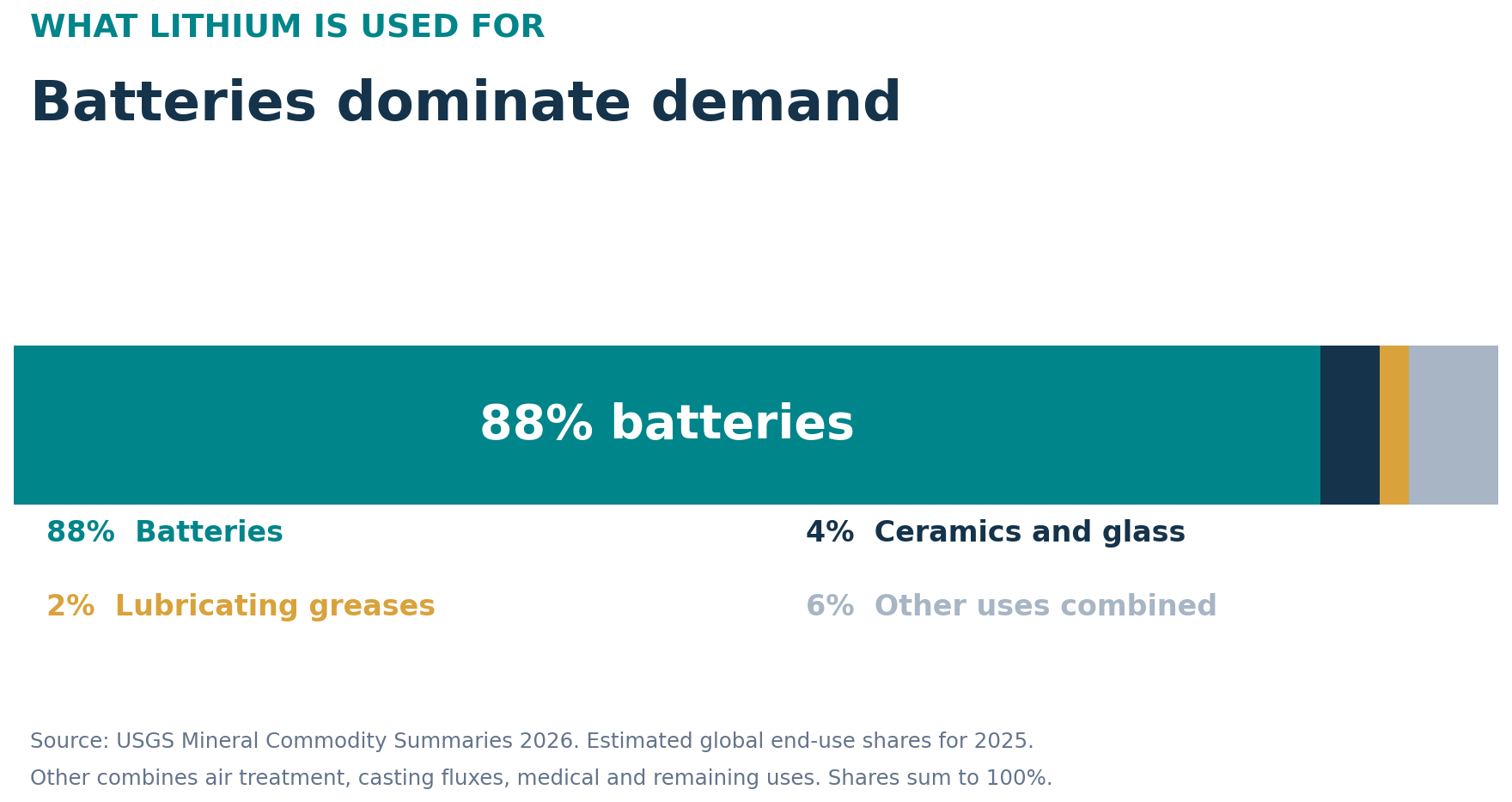
USGS estimates batteries accounted for 88% of global lithium use in 2025, followed by ceramics and glass at 4% and lubricating greases at 2%. The remaining 6% combines smaller applications. Source: USGS Lithium, 2026.
Lithium carbonate and lithium hydroxide are important inputs to battery production. The OECD explains that lithium carbonate serves several battery chemistries and other industrial uses, while lithium hydroxide is particularly relevant to nickel-rich batteries. The product specification therefore matters alongside the amount of lithium available. Source: OECD lithium supply-chain analysis.
Where lithium is produced
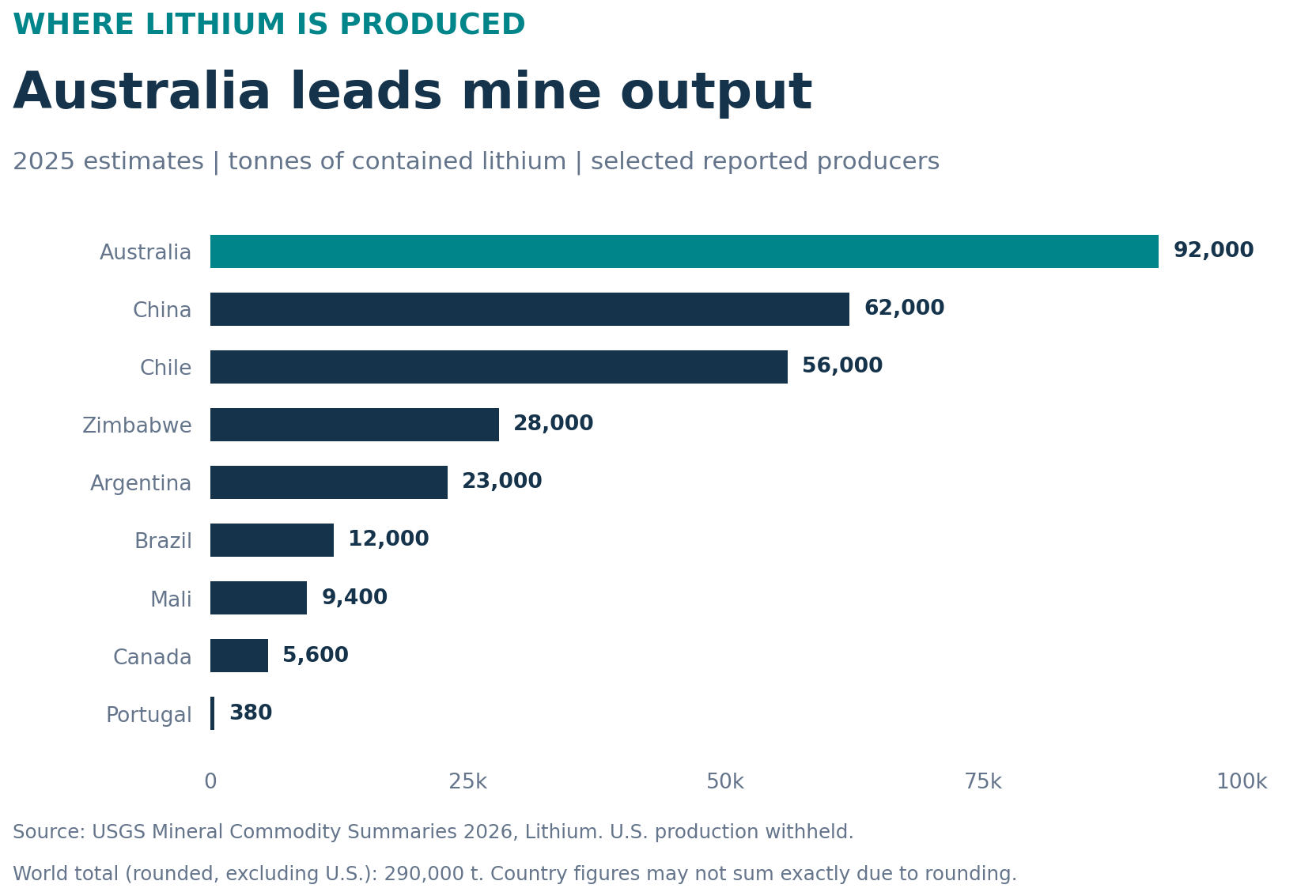
| Reported producer | 2025 estimate, tonnes lithium content |
|---|---|
| Australia | 92,000 |
| China | 62,000 |
| Chile | 56,000 |
| Zimbabwe | 28,000 |
| Argentina | 23,000 |
| Brazil | 12,000 |
| Mali | 9,400 |
| Canada | 5,600 |
| Portugal | 380 |
The rounded world estimate is 290,000 tonnes, excluding U.S. production. U.S. output is withheld to protect proprietary information. These figures measure lithium content, not ore, concentrate or lithium carbonate equivalent. Original source and footnotes.
Different deposits require different processing
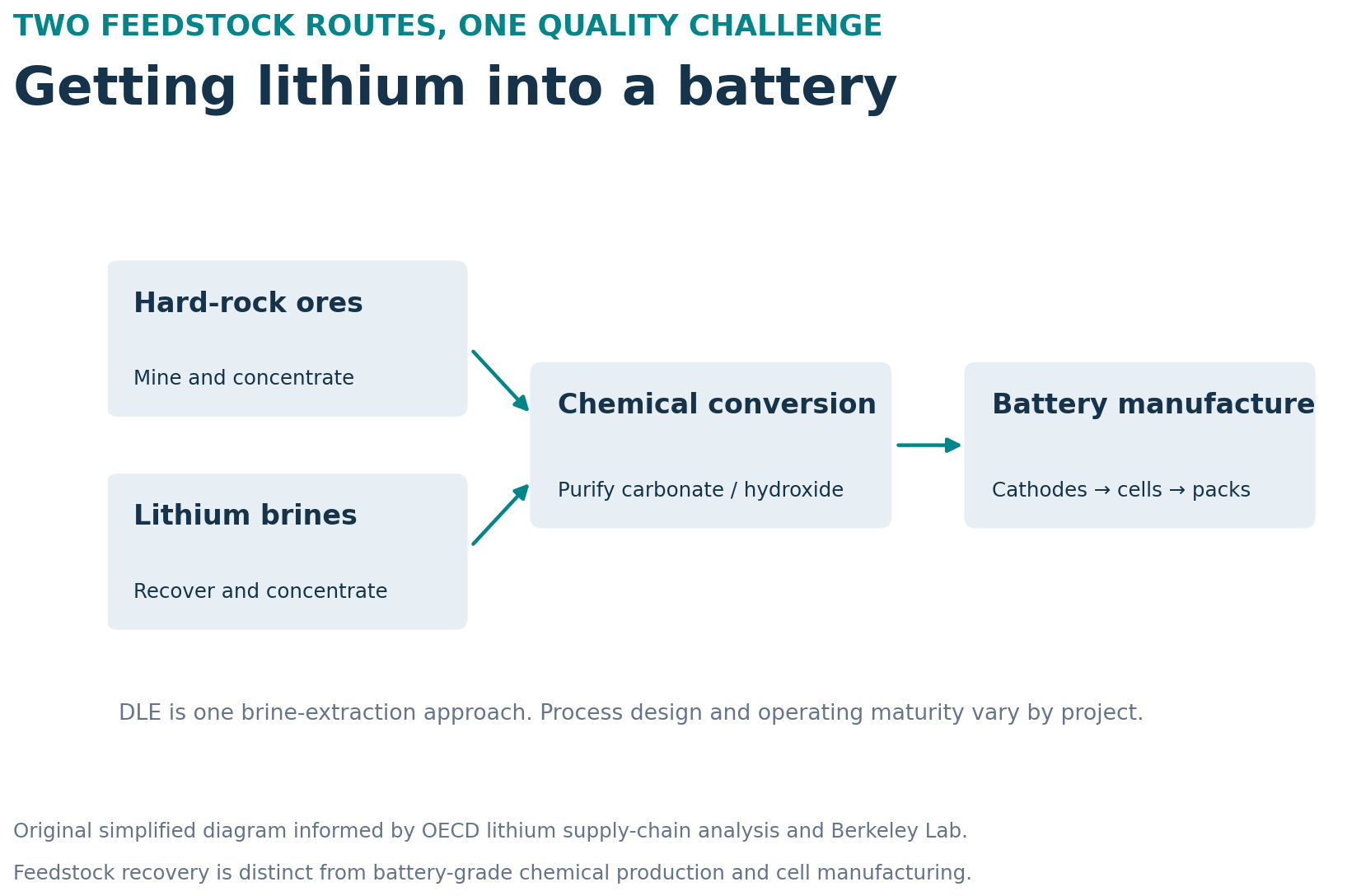
Hard-rock production begins with lithium-bearing ore and commonly produces a concentrate for further treatment. Brine operations recover lithium dissolved in saline fluids. Both routes require chemical processing to deliver suitable products; extracting lithium and manufacturing a battery are distinct activities. Recycling can provide a further feedstock from manufacturing scrap and retired batteries. Source: OECD.
Direct lithium extraction, or DLE, describes approaches for separating lithium from brines. One U.S. Department of Energy-backed University of Virginia project is developing electrically driven extraction and separation for geothermal brine. DOE describes a progression from early proof of concept toward validation in a relevant environment. That research milestone should be recorded as technology development, rather than commercial production. Source: DOE project spotlight.
Berkeley Lab explains that recovered lithium chloride needs additional refining into battery-grade carbonate or hydroxide. Its Salton Sea guidance also notes that geothermal operations and DLE consume freshwater for some activities. A technology label alone therefore cannot establish a project’s water demand or its environmental performance. Source: Berkeley Lab FAQ.
Read the units before comparing projects
| Measure | What it means | How to use it |
|---|---|---|
| Contained lithium (Li) | Mass of the lithium itself. | Basis of the USGS production table above. |
| Lithium carbonate equivalent (LCE) | A common basis for comparing lithium compounds. | 1 tonne Li ≈ 5.32 tonnes LCE; conversion changes the unit, not supply. |
| Ore or concentrate | Mass of feed material, including other components. | Retain grade and recovery assumptions; do not equate it with Li content. |
| Capacity versus output | Designed throughput versus production achieved. | Store announced capacity and reported annual output separately. |
Berkeley Lab gives a conversion factor of 5.32 tonnes of LCE for one tonne of lithium. For example, 10,000 tonnes of contained lithium corresponds to about 53,200 tonnes LCE. This is a change in reporting basis, not a forecast of saleable output. Product purity and process recovery still need their own evidence. Conversion source.
A global hub, including emerging suppliers
The production table provides a common baseline for coverage across Oceania, Asia, the Americas, Africa and Europe. Country profiles should then connect that baseline to the relevant extraction and processing stages. The OECD highlights water management as a major concern in arid producing regions and notes that estimates can vary with the assessment method and brine characteristics. Such comparisons need consistent boundaries. Source: OECD.
India belongs in the exploration and development coverage. In March 2026, the government reported preliminary survey work in Degana, Rajasthan, and exploration efforts in Reasi, Jammu and Kashmir. Those activities should be followed through documented exploration, assessment and development milestones. They should not be added to the operating mine-output table as production. Source: government statement, March 25, 2026.
Sources, project checks and updates
For each project added to this hub, record location, owner, feedstock, product, development stage and the date of the supporting disclosure. Keep exploration results, feasibility assumptions, construction targets, commissioning and sustained production as separate milestones. A financing announcement or extraction trial can be newsworthy while leaving commercial output unproven.
For future market updates, identify the exact chemical, purity, delivery basis, currency and quotation date behind any price. Retain the original units and distinguish spot assessments from contract prices. This profile deliberately uses dated physical-supply data rather than mixing incompatible price series into a single headline number.
Missing data should remain unavailable. Record estimates as estimates, preserve source revisions and avoid treating a national resource announcement as economically recoverable reserves. This structure will allow subsequent country pages and the project tracker to use the same evidence standards.