
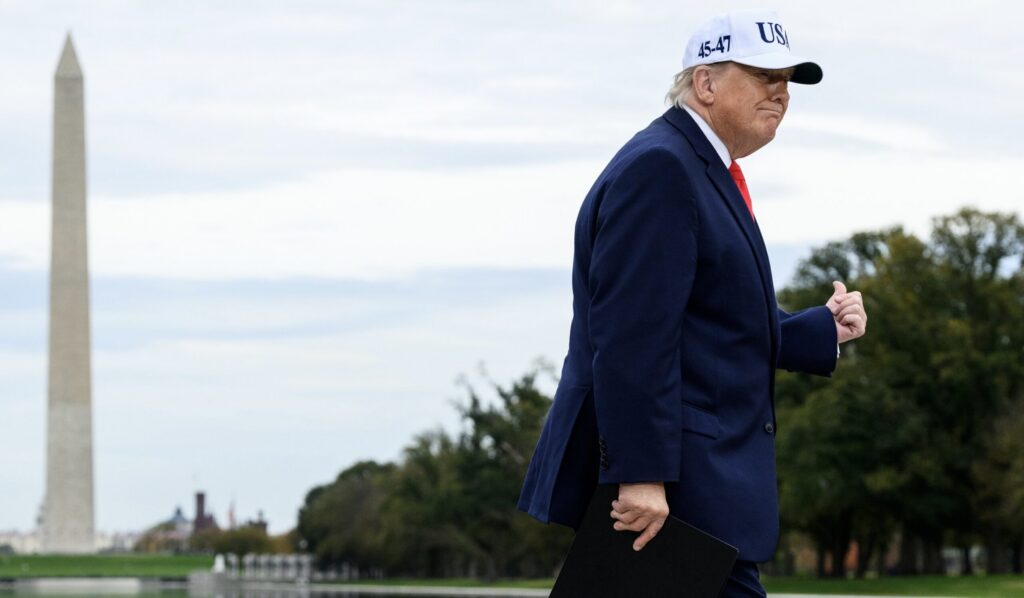
President Donald Trump’s ambitious plans to expand American mining, accelerate energy production and strengthen domestic mineral supplies face a major political test after Democrats captured both chambers of Congress in the November 3 midterm elections. The shift threatens to complicate federal mining investments, tighten oversight of artificial intelligence infrastructure and reshape the administration’s industrial strategy.
Yet the Democratic victory presents an unusual contradiction for America’s energy industry. While congressional investigations and regulatory scrutiny could slow projects, mounting electricity costs and an increasingly strained power grid may force both parties into negotiations over faster approvals for mines, pipelines and transmission networks.
The stakes extend beyond Washington. Gold has climbed back above $4,000 an ounce amid expectations of a weaker dollar and reduced fiscal flexibility for Trump, while copper faces competing pressures from potential restrictions on AI data centers and persistent physical supply shortages.
Industry assessments from BMO, TD Securities and Wood Mackenzie suggest that the election could reshape investment decisions across mining, power generation, natural gas infrastructure and critical minerals when the new Congress convenes in January 2027.
“While we see the likelihood for permitting reform, how policy is legislated and implemented remains a risk to the U.S. economy,” David Brown, Wood Mackenzie’s director of global integrated energy research, said Wednesday.
“Entrenched partisanship could fuel policy stagnation and regulatory confusion.”
Democrats Target Trump’s Mining Investments and AI Expansion
One of the most immediate challenges concerns the Trump administration’s growing willingness to use federal financial resources to support private mining companies.
The strategy is intended to strengthen domestic production of critical minerals and reduce dependence on foreign suppliers, particularly China. But it has raised questions about whether Washington can simultaneously regulate mining companies and hold financial interests in them without creating conflicts of interest.
In August, Democratic Senator Martin Heinrich and Representative Jared Huffman called for a Government Accountability Office investigation into the safeguards governing federal mining investments.
The lawmakers sought an examination of how federal agencies assess investment risks, protect taxpayers and handle permitting decisions involving companies receiving government financial support.
Their concerns could now become the foundation for congressional hearings, document requests and investigations.
With Democrats controlling the House and Senate, the administration may face greater pressure to disclose the financial terms of mining investments and explain how regulatory decisions are insulated from commercial interests.
BMO also identified the possibility of investigations involving presidential family business interests, alongside delays or opposition to executive appointments requiring Senate confirmation.
The political change could have consequences for companies seeking federal financing, loan guarantees or accelerated environmental approvals.
However, increased oversight does not necessarily mean a reversal of American critical minerals policy. Reducing dependence on imported strategic materials has attracted support from both parties, particularly as China remains central to global mineral processing and supply chains.
The larger uncertainty is whether Democratic lawmakers will seek to modify the administration’s investment model or challenge specific transactions.
Second Flashpoint: Rapid Expansion of AI Data Centers
These facilities require enormous amounts of electricity, extensive cooling systems and substantial quantities of copper for power distribution and electrical infrastructure.
Democratic scrutiny of data center development could introduce tougher requirements related to electricity consumption, environmental impacts and infrastructure costs.
That prospect matters to copper producers because AI infrastructure has become an important source of expected demand growth.
TD Securities strategists Ryan McKay and Bart Melek said copper initially weakened after the election as investors considered the possibility of greater restrictions on data center construction.
Prices subsequently recovered as tight physical supplies, particularly in China, supported the market.
Russ Mould, investment director at British investment platform AJ Bell, warned that additional AI regulation could affect one of the stock market’s strongest investment themes.
“Given that AI has been the key to considerable stock market wealth creation in recent years, the prospect of red tape could put the brakes on this hot investment theme,” Mould said.
“However, a positive market reaction implies that certain investors are welcoming the potential that Trump’s political power may be curbed somewhat.”
The distinction is important for mining investors. Slower data center construction could weaken some forecasts for future copper consumption, but it would not automatically resolve shortages caused by mine development delays, declining ore grades or constrained processing capacity.
Gold Gains as Electricity Costs Create Pressure for a Political Deal
Gold emerged as one of the clearest beneficiaries of the political uncertainty.
The metal rose 2.7% to $4,038 an ounce in an early trading snapshot cited by AJ Bell, crossing the psychologically important $4,000 threshold.
TD Securities strategists attributed the renewed strength partly to expectations that Democratic control of Congress could constrain Trump’s fiscal agenda.
Reduced prospects for additional federal spending could put downward pressure on the dollar and longer-term Treasury yields, conditions that generally support non-yielding assets such as gold.
Political uncertainty also increases the appeal of gold as a defensive investment, although its direction will continue to depend on interest rates, inflation expectations and broader financial conditions.
The election’s impact on metals tariffs is likely to be more limited.
According to BMO, tariffs imposed under Section 232 on steel, aluminum and copper products remain largely within presidential authority.
Potential tariffs on refined copper from January could therefore proceed despite the Democratic victory.
The bank noted that similar trade measures survived Democratic gains in the 2018 midterms and that protection for strategic domestic industries retains substantial bipartisan support.
For the mining sector, this creates a divided policy outlook: greater scrutiny of federal investment and permitting decisions, but continued political support for tariffs designed to protect domestic production.
The strongest opportunity for cooperation may instead emerge from electricity affordability.
Wood Mackenzie estimates that wholesale US power prices could increase 46% between 2026 and 2035 under its base-case forecast.
Rapid growth in data centers, industrial electrification and other infrastructure is expected to increase demand for generation capacity and transmission networks.
The consultancy forecasts 166 gigawatts of net new gas-fired generating capacity during that period.
Delivering that capacity would require substantial investment in natural gas pipelines, power plants and supporting infrastructure.
Without faster approvals, new generating facilities could struggle to obtain sufficient fuel, while transmission constraints could prevent electricity from reaching high-demand regions.
“Without reform, midstream bottlenecks are likely to return, stifling upstream investment and pushing regional gas and power prices higher, most acutely in the power-hungry Northeast,” said Siddhant Warrier, Wood Mackenzie’s North American power research analyst.
“Prolonged pipeline delays would also slow data center development, a high priority for both parties.”
The pressure is not confined to natural gas.
High-voltage transmission line completions during the 2020s have been running at less than half the pace recorded in the previous decade, according to Wood Mackenzie.
Even if Congress accelerates federal approvals, disagreements over who pays for transmission lines crossing multiple utility territories could continue to delay projects.
Divided government might still produce
The Bipartisan American Affordability and Jobs Act, introduced before the election, offers a potential framework.
Sponsored by Republican Senators Shelley Moore Capito and Mike Lee alongside Democratic Senators Sheldon Whitehouse and Martin Heinrich, the proposal seeks to accelerate environmental reviews and reduce prolonged litigation over energy and mineral projects.
Among its provisions are two-year timelines for environmental impact reviews, a 150-day window for legal challenges following environmental approvals and a nine-month timetable for certain dredge-and-fill permit evaluations associated with gas pipelines.
The legislation would also restrict the circumstances under which agencies could revoke previously issued permits.
But Democratic support for faster approvals does not mean lawmakers will accept the existing package unchanged.
Huffman criticized the Senate proposal in September, arguing that it needed stronger safeguards for affected communities, wildlife and renewable energy development.
He also questioned the political logic of accepting a compromise before Democrats had greater negotiating leverage.
“Folding our hand now or in the lame duck makes no sense,” Huffman said.
His position has acquired greater significance following the election.
Democrats will have stronger negotiating power from January, potentially enabling them to demand additional environmental protections and changes to the treatment of renewable energy projects.
Trump, however, will retain presidential veto authority, limiting the scope of legislation that Democrats can enact without Republican support.
Wood Mackenzie considers major new renewable energy subsidies unlikely to survive a presidential veto.
The immediate test comes on November 9, when the Senate is scheduled to hold a procedural vote on advancing the legislative vehicle for permitting reform.
That vote could determine whether lawmakers attempt to reach an agreement during the remaining weeks of Republican congressional control or leave negotiations to the incoming Democratic majority.
For mining companies, energy developers and infrastructure investors, the outcome could determine how quickly projects move from financing to construction.
A comprehensive agreement could ease some of the delays affecting critical minerals production, natural gas infrastructure and electricity transmission.
Failure could leave companies navigating competing federal and state requirements, prolonged litigation and uncertainty over the administration’s investment priorities.
The broader consequence of the midterm elections is therefore not necessarily the dismantling of Trump’s mining and energy strategy.
Instead, the industry faces a period in which federal financial intervention, environmental regulation, energy affordability and infrastructure development will be contested more aggressively in Congress.
For investors, the central question is whether political confrontation will delay the infrastructure America needs or whether rising power bills will create enough pressure for Democrats and Republicans to reach a compromise.