
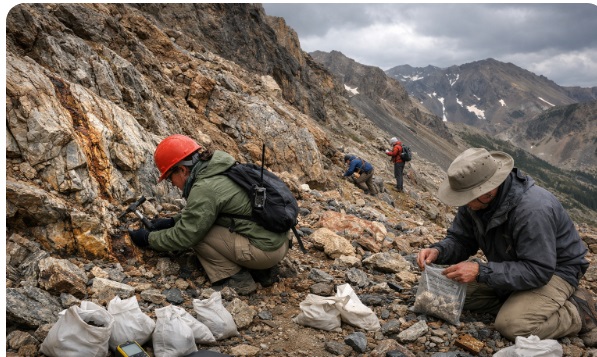
India and the United States have signed a strategic agreement to strengthen cooperation in critical minerals and rare earth elements, a move aimed at securing supply chains for key industries and reducing dependence on China, which currently dominates the global market for these resources.
The agreement was signed on the sidelines of the Quad Foreign Ministers’ Meeting in New Delhi in the presence of External Affairs Minister S. Jaishankar and US Secretary of State Marco Rubio.
Critical minerals and rare earths are essential components in the manufacturing of semiconductors, electric vehicles, solar panels, batteries, advanced electronics and defence equipment. The agreement comes amid growing concerns among major economies over China’s overwhelming control of mining, processing and refining capacities for these strategic materials.
Announcing the pact, Jaishankar said the framework would deepen cooperation across the entire critical minerals value chain, including exploration, mining, processing, recycling, technology sharing and investments.
“We are today signing a bilateral India-US framework on securing supplies of mining and processing of critical minerals and rare earths. This is something we have also discussed today at the Quad meeting and whether we are doing it bilaterally, or in the Quad format or as a larger gathering of like-minded nations, it is something very timely and critical,” he said.
The agreement is expected to facilitate collaboration between government agencies and private sector companies in both countries to develop resilient and diversified supply chains.
No dependency on single supplier nation
Rubio said the partnership reflects the shared strategic interests of India and the United States in ensuring that future technologies are not dependent on a single supplier nation.
“India and the United States have a strategic and shared interest in the fact that vibrant innovation economies such as ours cannot afford to leave the foundational materials of these industries vulnerable to single-source monopolies that could deny us these things, not just in a time of conflict, but as a leverage point contrary to our sovereign national interests,” he said.
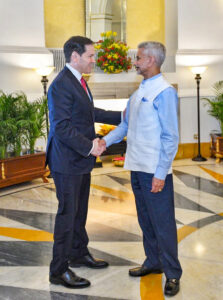
He described the agreement as a tangible example of the growing strategic partnership between Washington and New Delhi and emphasised the importance of ensuring reliable long-term access to resources vital for innovation-driven economies.
The development comes as China has tightened export controls on several rare earth elements and strategic metals over the past year, intensifying concerns among major economies about supply disruptions in sectors such as artificial intelligence, clean energy, aerospace and advanced manufacturing.
Alongside the bilateral agreement, Quad nations — India, the US, Japan and Australia — also unveiled a broader framework on critical minerals cooperation aimed at building secure and diversified supply chains across the Indo-Pacific. The grouping discussed joint investments, processing partnerships and regulatory cooperation to reduce vulnerabilities linked to concentrated supply sources.
QUAD’s New Initiative: Critical Minerals Forum
The Quad meeting additionally announced new initiatives on maritime security, energy resilience and strategic infrastructure development, including a joint port project in Fiji, reflecting the bloc’s growing focus on economic security and regional supply chain stability.
The groundwork for the India-US agreement was laid earlier this year when India participated in the Critical Minerals Forum hosted in Washington, D.C., on February 4. The initiative brought together governments and industry stakeholders to address vulnerabilities in global supply chains and promote cooperation among trusted partners.
Rubio also highlighted India’s participation in the Pax Silica Declaration, a US-led strategic coalition focused on securing supply chains for artificial intelligence, semiconductors, advanced manufacturing and critical minerals. India formally joined the initiative in February, marking a significant step in technology and supply-chain cooperation between the two countries.
Experts say the new framework could help India attract investment into mineral exploration, refining and processing, areas where China currently holds a dominant position. India possesses significant reserves of rare earth-bearing minerals and has been seeking international partnerships to develop domestic capabilities in extraction and value-added processing.
The agreement is expected to support India’s ambition to emerge as a global manufacturing hub for electric vehicles, batteries, semiconductors and clean-energy technologies while helping the US and its allies diversify sourcing networks away from China.
As global demand for lithium, cobalt, nickel, graphite and rare earth elements continues to rise, access to critical minerals is increasingly being viewed as a strategic economic and national security priority. The India-US pact signals a broader effort among like-minded nations to build alternative supply chains capable of supporting future technological and industrial growth.