
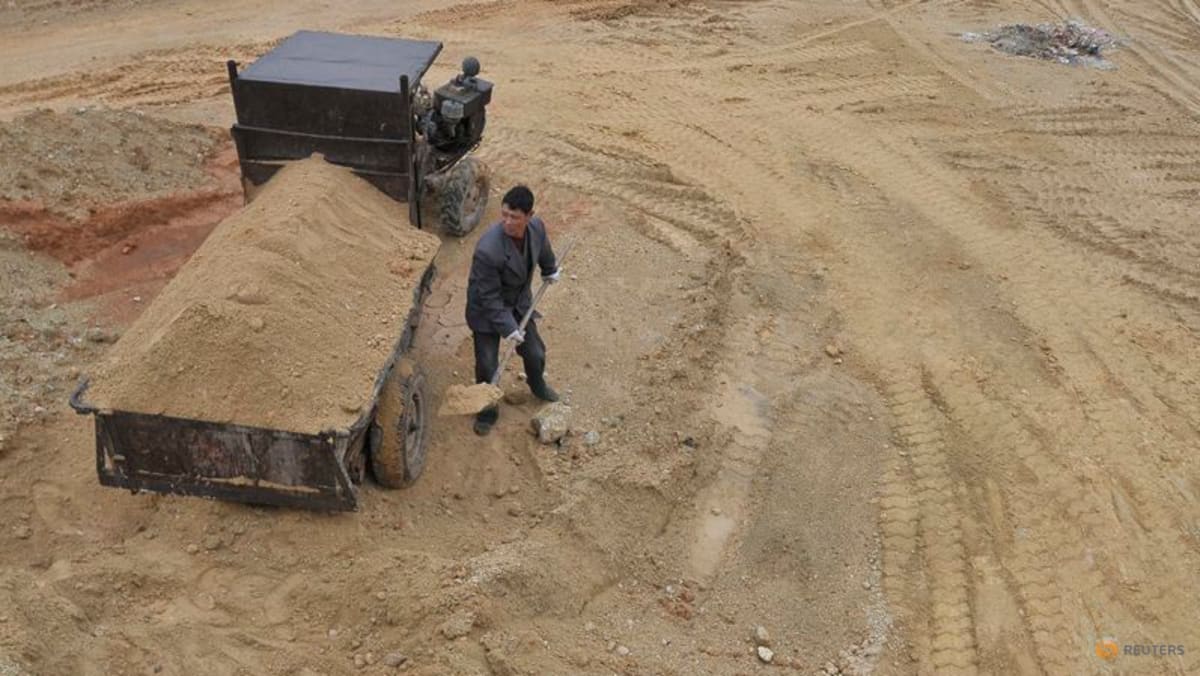
Chinese authorities have unveiled a massive expansion of the nation’s critical mineral reserves, announcing what geologists describe as a “super-large” discovery of rare earths, fluorite, and baryte in Sichuan province, alongside a significant antimony find in Gansu. The announcement, made on Friday, comes as Beijing and Washington intensify their rivalry over control of the supply chains essential for high-tech manufacturing, defence, and green energy.
The discoveries, confirmed by the Chinese Academy of Geological Sciences and provincial natural resources departments, solidify China’s already dominant position in the global critical minerals market—a sector Beijing has increasingly leveraged in its trade and technology disputes with the United States.
Sichuan: A ‘Super-Large’ Triple Discovery
The most significant findings were reported at the Maoniuping mine in Mianning county, Sichuan province. Geological surveys have identified an additional 9.7 million tonnes of rare earth oxides, bringing the site’s confirmed reserves to a total of 10.4 million tonnes.
However, officials highlighted that the discoveries of fluorite and baryte at the same site were equally consequential. The survey identified 27.1 million tonnes of fluorite and 37.2 million tonnes of baryte.
“The scale of these findings means the deposit qualifies as a ‘super-large’ reserve for both minerals,” a statement from the local geological bureau said, citing official classification standards.
Wang Denghong, Director of the Institute of Mineral Resources at the Chinese Academy of Geological Sciences, emphasized the industrial significance of the non-rare earth findings, particularly fluorite, which is crucial for the semiconductor and lithium battery industries.
“Fluorite, commonly referred to as fluorspar, plays an important role in the semiconductor and lithium-ion battery industries,” Wang said, explaining its role in the supply chain for cutting-edge electronics and energy storage.
Speaking on the strategic importance of baryte, Wang added: “Without baryte, oil and gas exploration and production would grind to a halt, and the extraction of shale oil and gas would be out of the question.”
Gansu Province: Antimony Reserves Surge
In a separate development, authorities in Gansu province reported a major addition to the nation’s antimony reserves. Following surveys in Tanchang county, officials confirmed an additional 51,455 tonnes of the critical mineral.
A spokesperson for the Gansu Provincial Department of Natural Resources told state media that the discovery increases the area’s proven antimony reserves “by more than half.”
Antimony is a critical component in the defence and electronics sectors, commonly used as a flame retardant in plastics and electronic products, as well as a hardening agent in lead alloys for military applications.
Export Controls and the Geopolitical Context
The discoveries come amid heightened scrutiny of China’s export policies on critical minerals. Last April, Beijing imposed export restrictions on seven rare earth elements and permanent magnets, requiring exporters to obtain official permission before shipping restricted materials abroad.
While China confirmed in December that it had begun issuing longer-term export licences with extended validity, customs data released on Friday revealed a continued divergence in trade flows.
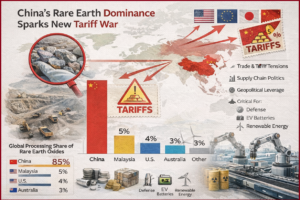
Exports of rare earth permanent magnets to the United States totalled 994 tonnes in January and February, marking a 22.5 per cent drop compared to the same period last year. Conversely, shipments to the European Union surged, reaching 4,775 tonnes—a 28.4 per cent year-on-year increase.
Analysts view the data as evidence of Beijing’s calibrated approach: maintaining stable supplies to European partners while continuing to restrict access to the US market amid unresolved tariff disputes.
Official Stance: ‘Strengthening Resource Security’
In a briefing following the announcement, a spokesperson for the Ministry of Natural Resources framed the discoveries as a matter of national strategic security.
“These new findings significantly strengthen China’s resource security for critical minerals essential to high-tech, new energy, and national defence sectors,” the spokesperson said, as per a transcript released by Xinhua.
The official added that the Ministry would continue to support deep exploration efforts across the country. “Securing our domestic supply chain for these strategic resources is a top priority. We are advancing exploration to ensure that China’s industrial and technological development rests on a solid, self-reliant foundation.”
The discoveries in Sichuan and Gansu represent some of the largest additions to China’s critical minerals inventory in recent years, reinforcing its capacity to influence global prices and supply chains at a time when the United States and its allies are seeking to reduce their dependence on Chinese-controlled resources.