
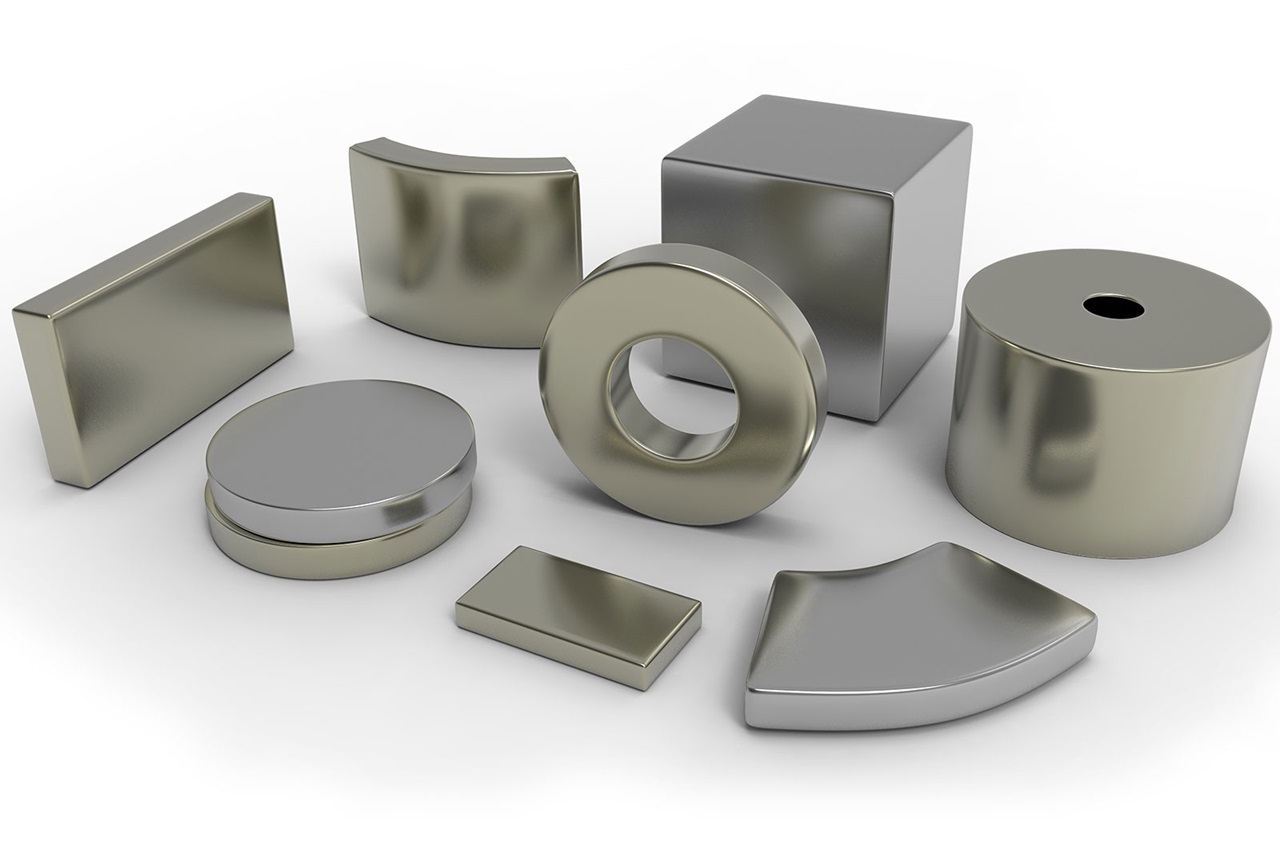
Human fascination with magnetism stretches back millennia. Ancient Greek scholars are believed to have identified the unusual magnetic properties of certain metals nearly 4,000 years ago. What began as curiosity has since evolved into one of the most critical technologies underpinning modern life.
Today’s permanent magnets are indispensable. They sit quietly inside everyday products such as loudspeakers, headphones and toys, and play far more strategic roles in electric vehicles, wind turbines, industrial motors and military systems. Most high-performance permanent magnets are made from a neodymium–iron–boron (NdFeB) alloy, prized for its exceptional magnetic strength relative to size.
How Permanent Magnets Are Made
Manufacturing these magnets is a precise, multi-stage industrial process. It starts with melting carefully selected raw materials, which are then cast into moulds and rapidly cooled. The resulting solid is crushed into a fine powder.
This powder is the key. Each microscopic particle must be aligned in exactly the same magnetic direction to produce a strong, stable magnetic field. Once aligned, the powder is sintered in a high-temperature furnace, fusing the particles into a dense solid block. That block is then cut, shaped and finished for use in specific applications.
A Western Invention, Globalised Production
Modern permanent magnets were not originally a Chinese innovation. They were developed in the 1980s through parallel breakthroughs in the research laboratories of General Motors and by Japanese materials scientist Masato Sagawa, whose work revolutionised magnet performance.
However, the production process comes with a heavy environmental cost. The extraction and processing of rare earth elements can generate radioactive byproducts capable of contaminating water sources and soil if not carefully managed.
As environmental regulations tightened across the US and Europe in the 1980s, much of this polluting work was effectively offshored. Western suppliers began exporting rare earth materials to China, which was willing to process them despite the environmental risks. According to experts at Imperial College London, this shift played a decisive role in concentrating global magnet manufacturing capacity in China.
Can The West Rebuild Its Magnet Industry?
There are early signs of reversal. GM is now working with Mountain Pass Mine, currently the only operational rare earth mine in the United States. Industry estimates suggest it could be around two years away from producing magnet-ready materials for domestic use.
The technical know-how, many argue, never truly disappeared. What changed were environmental standards, industrial priorities and supply-chain economics.
As one researcher puts it bluntly: there is no technological barrier to making powerful magnets in the West again. After all, they were invented there. The real challenge lies in reconciling clean production with the growing demand for the magnetic engines of the modern world.