
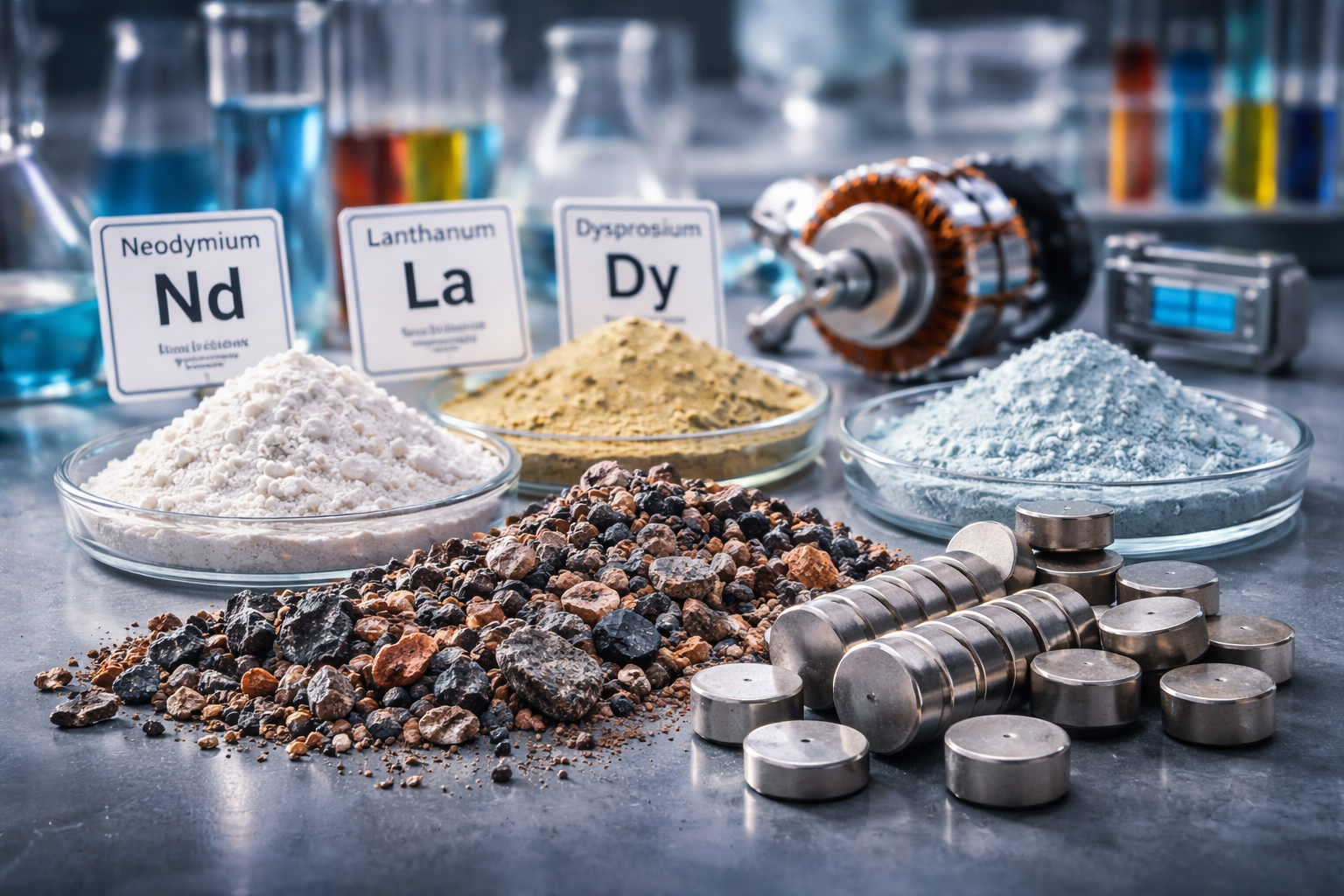
Three Indian companies have received licences from Chinese authorities to import rare earth magnets, offering partial relief to India’s automotive and electronics industries that were hit by Beijing’s export restrictions earlier this year, the government said on Thursday.
Ministry of External Affairs spokesperson Randhir Jaiswal confirmed that some Indian firms have secured approvals to import rare earth magnets from China. At least three companies — Continental India, Hitachi and Jay Ushin — have obtained initial clearances, according to officials familiar with the process.
The companies supply critical components to India’s automotive and electronics sectors, including manufacturers of electric vehicles (EVs), which have been among the worst affected by the supply curbs.
“This is the first set of clearances since Beijing imposed tight controls on the export of these magnets in April,” Jaiswal said, adding that the approvals were intended to ease supply disruptions faced by Indian industry.
China’s move in April to tighten export controls on certain rare earth products had disrupted global supply chains, affecting automakers and clean-energy manufacturers across multiple countries. India, which remains heavily dependent on imports for rare earth magnets, saw bottlenecks emerge particularly in EV manufacturing, where such magnets are essential for electric motors.
Conditions attached to licences
Officials said the licences granted to Indian firms come with strict conditions. The imported magnets cannot be re-exported to the United States and cannot be used for defence-related applications, reflecting Beijing’s sensitivity around downstream usage and geopolitical considerations.
Jaiswal acknowledged the broader geopolitical context surrounding rare earth trade, saying, “We have to look at how the US and China talks will play into our domain.”
The Ministry of External Affairs had earlier confirmed, in June 2025, that India was in discussions with Chinese authorities to secure rare earth supplies and bring greater predictability to the trade channel. Those talks gained urgency after export restrictions began to bite into production schedules for Indian manufacturers.
Industry bodies and government departments have since been working to find stop-gap solutions to ease shortages while India accelerates efforts to build domestic capacity for rare earth magnet manufacturing.
Impact on Indian industry
Rare earth magnets are critical inputs for electric vehicles, consumer electronics, industrial machinery and renewable energy systems. The automotive sector, particularly EV makers, had warned that prolonged supply disruptions could slow production and delay new model launches.
Industry executives said the initial grant of licences would help stabilise operations in the near term, although they cautioned that the approvals cover only limited quantities and do not eliminate longer-term vulnerability.
“This provides breathing space, but it doesn’t change the structural dependence,” said a senior executive at an auto components firm, who declined to be named. “That’s why domestic manufacturing plans are being pushed so hard.”
Parallel U.S.–China development
The announcement of Chinese licences to Indian firms came as the United States and China signalled a temporary easing of tensions over rare earth supplies.
U.S. President Donald Trump said on Thursday that he and Chinese President Xi Jinping had agreed to a one-year deal to ensure the supply of crucial rare earth materials.
The understanding was reached after the two leaders met in Busan, South Korea, on the sidelines of the 32nd APEC Economic Leaders’ Meeting, marking their first in-person meeting in six years.
“All the rare earths have been settled, and that’s for the world,” Trump told reporters aboard Air Force One after the meeting. He said the agreement would be renewed annually and described it as significant progress in strained U.S.–China trade relations.
Trump also said he had agreed to reduce fentanyl-related tariffs on China from 20% to 10%, adding that “a lot of things we brought to finalisation” during the talks and praising Xi as “a tremendous leader of a very powerful country.”
Strategic implications for India
Analysts say the developments underline how deeply rare earths have become entwined with geopolitics. While the licences from China may ease immediate supply pressures for Indian firms, they also reinforce concerns about over-reliance on a single source.
India has in recent months announced incentive schemes and overseas partnerships aimed at building domestic rare earth magnet capacity and securing alternative sources of raw materials. However, those efforts will take time to translate into meaningful output.
For now, the limited import clearances are expected to help Indian manufacturers manage near-term production risks, even as policymakers continue to push for longer-term self-reliance in critical minerals.