
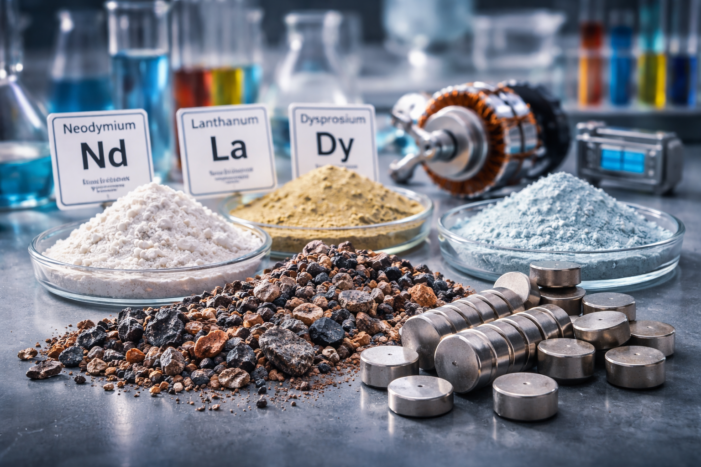
In a major push for strategic self-reliance, the Indian government has approved a ₹73 billion (approximately $800 million) incentive package to build a domestic industry for rare earth permanent magnets. The move targets China’s overwhelming dominance in a sector vital for electric vehicles, wind turbines, consumer electronics, and advanced defense systems.
The plan, cleared in November 2025, aims to produce 6,000 tonnes of these high-strength magnets annually within seven years. Officials are betting that focusing on this high-value end product, rather than the entire rare earth supply chain, will deliver faster results. The initiative comes as India’s demand for magnets, driven by its clean energy and electronics boom, is projected to double in the next five years.
High-Stakes Dependency on China
The urgency stems from acute vulnerability. India currently imports 80 to 90% of its magnets and related materials from China, which controls over 90% of the world’s processed rare earths.
The increasing dependence turned into a crisis in 2024 when Beijing tightened exports during a trade dispute, disrupting Indian automotive and electronics manufacturing. While restrictions eased, the shock revealed a lack of domestic buffer.
“The curbs underscored how exposed Indian industry remains,” a senior official involved in the policy said, speaking on condition of anonymity.
Bridging a Decades-Long Technology Gap
Industry experts warn that financial support alone cannot overcome a profound technological deficit. Unlike Japan or Germany, India has scant commercial experience in the precise metallurgy required for high-performance magnets.
“This is a step in the right direction, but it’s only a beginning,” said Neha Mukherjee, an analyst at Benchmark Mineral Intelligence. “India will need deep partnerships to import technology, train skilled workers, and gradually build indigenous know-how.”
Dr. P.V. Sunder Raju of the National Geophysical Research Institute echoed the sentiment, cautioning that “funding without sustained research and development will not yield globally competitive products.”
The Raw Material Paradox
India possesses the world’s third-largest rare earth reserves, roughly 8% of the global total, found in coastal sands across several states. Yet, it accounts for less than 1% of global production. Only one mine, in Andhra Pradesh, is currently operational.
Furthermore, the country’s geology presents a specific challenge. While it has surpluses of lighter elements like neodymium, it lacks viable quantities of heavier rare earths such as dysprosium and terbium, which are essential for magnets that perform in high-temperature environments like EV motors.
This creates a potential contradiction: magnets may be assembled in India, but critical refined inputs may still need to be sourced from abroad, likely China.
Scale, Cost, and the Long Game
Even if production targets are met, capacity may lag behind demand. India already consumes about 7,000 tonnes of magnets per year, a figure rising swiftly. Competing on cost with China’s established, scaled industry remains another formidable hurdle.
“The scheme’s real value lies in kick-starting an ecosystem rather than delivering instant self-sufficiency,” said Rajnish Gupta, a partner at EY India. “The hope is that Indian players will keep investing entrepreneurial energy and build momentum.”
The program signals a strategic awakening in New Delhi. While dismantling China’s dominance will not happen overnight, the consensus is clear: in the geopolitics of critical minerals, doing nothing is no longer an option.

India Bets $800 Million to Break China’s Grip on Crucial Magnets added by Arun Nag on
View all posts by Arun Nag →
Pingback: Coal India Explores Rare Earth Partnerships in Australia, Russia, Africa - Rare Earths Watch