
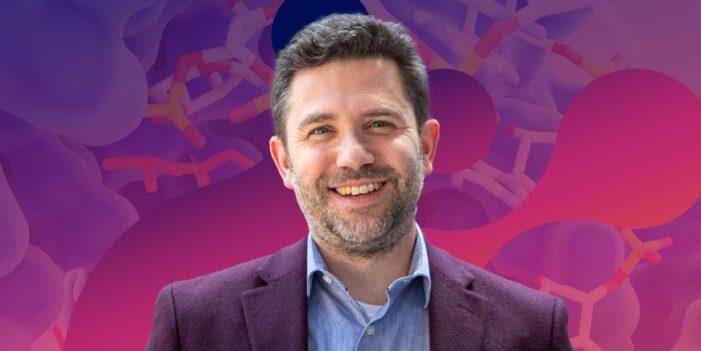
Joseph Cotruvo, Jr.’s quest to understand how living cells handle metals started with a simple scientific question. But along the way, his work has led to something much bigger: breakthrough techniques for purifying and detecting rare earth elements, advances that hold promise for U.S. supply security and environmental cleanup.
The journey began in the lab with a curious bacterium, Methylobacterium extorquens, which naturally uses certain lanthanides, a subset of rare earth metals, in its metabolism. Cotruvo wanted to know how the microbe could be so picky. “There are 17 rare earths, but the organism could only use a subset. Why and how?” he recalls.
While purifying a lanthanide-dependent enzyme from the bacteria, he noticed another protein tagging along. It looked structurally similar to calcium-binding proteins but behaved differently. He named it lanmodulin and discovered it had a rare and remarkable ability: it could bind to specific rare earth elements with extraordinary selectivity.
Niche Finding
That might sound like a niche finding, but its implications are vast. Rare earth elements, which include metals like neodymium, dysprosium, and lanthanum, are chemically very similar. They carry the same +3 charge and have nearly identical sizes, making them notoriously difficult and expensive to separate using conventional industrial methods. Yet each has distinct high-tech applications, from powerful magnets in electric motors to phosphors in screens and lasers.
Today, the U.S. depends heavily on imports for these critical materials, creating economic and national security vulnerabilities. Cotruvo’s work with lanmodulin opens a new path. By leveraging biology’s innate precision, his team has developed protein-based methods to purify and detect rare earths more efficiently and sustainably.
“Cotruvo has made great strides toward implementing lanmodulin-based constructs for rare earth element extractions and separations, and as fluorescent sensors for rare earths,” wrote J. Martin Bollinger, a Penn State professor who nominated Cotruvo for recognition. “The value of his work is profound.”
Beyond Supply Chains
The applications extend beyond supply chains. Harvard professor Daniel Nocera pointed out that “the Mount Everest of lanthanide remediation is selectivity.” Lanmodulin’s ability to preferentially grab specific lanthanides could revolutionize the cleanup of rare earth contaminants from mining sites and electronic waste.
Cotruvo’s scientific curiosity was inspired early on. His father was a chemist at the EPA, and as an undergraduate, he worked with Ed Stiefel, who studied using bacteria and chemistry to tackle oil spills. “The combination of that work and seeing how my dad used chemistry at the EPA showed me that chemistry can be used to solve some really important problems,” Cotruvo said.
Now, his research continues to ask how organisms manage metals—a question that has unexpectedly positioned him at the forefront of critical materials innovation. Amy Rosenzweig of Northwestern University wrote that his work “epitomizes the combination of innovation, creativity, and impact.”
Cotruvo is scheduled to present his findings on lanmodulin and its industrial potential at the 2026 ASBMB Annual Meeting, where science meets real-world solutions—one metal-binding protein at a time.
earth, microbes, mining, Rare, solutions

Researcher’s Curiosity About How Cells Manage Metals Leads to Game-Changing Rare Earth Findings added by Naresh Kumar on
View all posts by Naresh Kumar →