
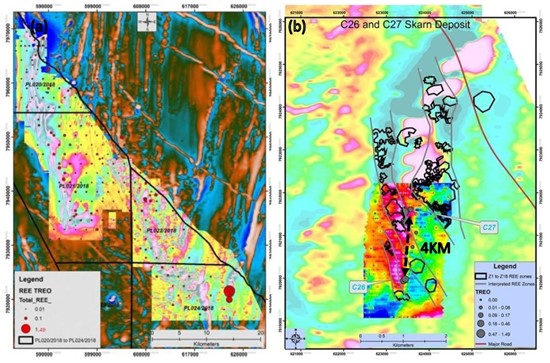
Tsodilo Resources Limited has confirmed the presence of significant rare earth and critical minerals mineralisation at its 100%-owned Gcwihaba Metals Project in northwest Botswana, following the verification of skarn-hosted deposits at two priority targets identified through geophysical surveys.
The C26 and C27 targets were first outlined as magnetic and gravity anomalies and subsequently tested through diamond core drilling, which intersected rare earth element (REE) mineralisation at shallow depths of roughly 20 to 50 metres below surface.
According to the company, the skarn zones host a polymetallic assemblage containing all 15 rare earth elements classified as critical by the U.S. Geological Survey in its 2025 list, along with other strategic minerals including copper, cobalt, nickel, vanadium and silver.
Permanent Magnets’ Input
Tsodilo said neodymium-praseodymium (NdPr), a key input for permanent magnets used in electric vehicles, wind turbines and defence applications, accounts for about 15% of total rare earth oxides (TREO) at the C26 and C27 skarns. This ratio is comparable to the NdPr proportion reported at MP Materials’ Mountain Pass operation in the United States.
Based on integrated interpretation of drilling data, magnetic and gravity modelling, and geological analysis, the company has outlined a conceptual exploration target ranging between 81 million and 97 million tonnes, with grades estimated from 0.05% to 1.49% TREO. The mineralised corridor extends over a strike length of approximately four kilometres. Tsodilo stressed that the target is conceptual in nature and that further drilling is required to define a mineral resource.
A 15,000-metre drill programme is planned for 2026, aimed at advancing the project towards an initial NI 43-101–compliant resource estimate.
Records Highest Grade Intercept
Commenting on the results, Tsodilo Chairman and Chief Executive Officer James M. Bruchs said the highest-grade intercept recorded to date, 1.49% TREO at the C27 target, underscored the potential scale and quality of the system.
“These results validate our systematic exploration approach and demonstrate a polymetallic REE skarn system with both vertical extent and grade,” Bruchs said. He added that in-house modelling using Paradigm GOCAD software had integrated geophysical inversions with drilling and geological interpretation to generate the current exploration target.
Beyond rare earths, the company reported encouraging associated metal values, including copper grades of up to 0.41% at C26, cobalt values reaching 320 parts per million, and silver assays of up to 5.1 grams per tonne at C27.
The upcoming drilling campaign will prioritise the delineation of higher-grade REE zones while continuing to assess the broader base and precious metals potential of the skarn system, the company said.

Canada Firm Tsodilo Confirms Large-Scale Rare Earth Find At Botswana Project added by Sridhar P on
View all posts by Sridhar P →