
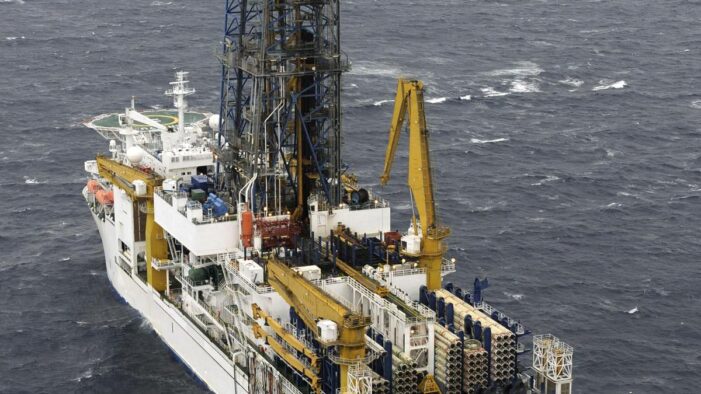
Japan has embarked on a high-stakes experiment beneath the Pacific Ocean as it seeks to loosen China’s grip on rare earth supplies critical to its economy and national security.
On Monday, the deep-sea research vessel Chikyu departed from Shizuoka port on a month-long mission to waters near Minamitori Island, a coral atoll located nearly 1,900 km southeast of Tokyo. The expedition aims to test whether mud deposits on the seabed, lying around six kilometres below sea level, can be continuously lifted to the surface and processed for rare earth elements.
If successful, the mission would mark a global first in deep-ocean rare earth recovery and represent a potential turning point in Japan’s long-running effort to reduce dependence on China, which currently dominates global rare earth processing and exports.
“After seven years of steady preparation, we can finally begin the confirmation tests. It’s deeply moving,” Shoichi Ishii, who heads the government-backed project, told Reuters as the ship set sail against the backdrop of snow-capped Mount Fuji. “If this project succeeds, it will be of great significance in diversifying Japan’s rare earth resource procurement.”
The vessel, carrying about 130 crew members and researchers, is scheduled to return on February 14.
Strategic urgency grows

Japan’s push comes as Beijing tightens export controls on minerals with both civilian and military applications. Last week, China banned exports of certain dual-use items to Japan’s military. The Wall Street Journal has also reported broader restrictions on rare earth shipments to Japanese firms, though Beijing has neither confirmed nor denied the move.
The issue is expected to feature prominently when finance ministers from the Group of Seven meet in Washington on Monday.
Japan has prior experience of supply vulnerability. In 2010, China curbed rare earth exports following a maritime dispute in the East China Sea, jolting Japanese manufacturers. Since then, Tokyo has cut its reliance on China to about 60% from nearly 90%, investing in overseas projects such as trading house Sojitz’s partnership with Lynas Rare Earths, while also promoting recycling and alternative manufacturing techniques.
Yet the Minamitori project is the first attempt to source rare earths domestically.
“The fundamental solution is to be able to produce rare earths inside Japan,” said Takahide Kiuchi, executive economist at Nomura Research Institute. He warned, however, that Japan remains almost entirely dependent on China for some heavy rare earths used in electric vehicle motors.
Long road ahead
The government has invested roughly 40 billion yen ($250 million) in the project since 2018. Estimated reserves remain undisclosed and no production targets have been set. A full-scale mining trial is pencilled in for February 2027 if current tests prove viable.
Costs remain a major hurdle, though analysts say prolonged supply disruptions and higher prices could eventually tip the economics in Japan’s favour.
China, meanwhile, is watching closely. During survey work last June, Chinese naval vessels sailed near the area—moves Ishii described as “intimidating.” Beijing said the actions complied with international law and urged Japan not to “hype up threats.”

Japan Begins Rare Earth Seabed Mission As China Squeezes Supply added by Sam Rozer on
View all posts by Sam Rozer →