
The global market for rare earth metals is poised for sustained expansion over the next decade, driven by accelerating demand from electric vehicles, renewable energy systems, advanced electronics and defence applications, according to a new industry report released on Wednesday.
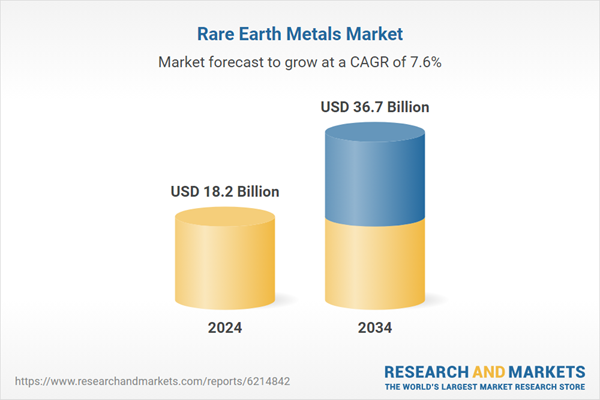
The global rare earth metals market was valued at $18.2 billion in 2024 and is projected to grow at a compound annual growth rate (CAGR) of 7.6%, reaching $36.7 billion by 2034, the report by ResearchAndMarkets.com said. The growth trajectory reflects the increasing reliance of modern industries on high-performance materials that are difficult to substitute.
Rare earth elements are essential inputs for technologies central to the global energy transition, including electric vehicle motors, wind turbines, high-efficiency electronics and precision defence systems. As governments and manufacturers accelerate electrification and decarbonisation plans, demand for these minerals has intensified.
At the same time, supply chain security has emerged as a strategic priority. Policymakers across major economies are encouraging new mining investments, recycling initiatives and the creation of strategic reserves to reduce dependence on a narrow set of producing countries and mitigate geopolitical risks.
Oxides and magnets dominate demand
By product type, individual rare earth oxides accounted for 50.1% of the global market in 2024 and are expected to expand at a CAGR of 7.7% through 2034, the report said. Demand for these materials is being driven by their growing use in advanced manufacturing and clean-energy technologies.
Elements such as neodymium, praseodymium and dysprosium are seeing particularly strong growth due to their critical role in high-performance permanent magnets. These magnets are widely used in electric vehicles, wind energy systems, consumer electronics and industrial automation, where efficiency, durability and compact design are essential.
By application, the magnets segment accounted for 37.5% of global demand in 2024, underlining its central role in the rare earth value chain. Permanent magnets made from rare earths are considered irreplaceable in many modern applications, including motors, turbines, medical devices and precision equipment.
Analysts say this segment will remain a key growth driver as electric mobility, renewable power generation and automation technologies scale up globally.
Asia-Pacific leads growth
Regionally, the Asia-Pacific rare earth metals market is forecast to grow at a CAGR of 8.3% through 2034, reinforcing its position as the world’s primary hub for rare earth mining, processing and manufacturing.
The region’s dominance is underpinned by China, which has extensive production and processing capacity and remains the largest consumer of rare earths due to its strong electronics, automotive and renewable energy industries. Rapid expansion of electric vehicle manufacturing, offshore wind projects and semiconductor production across Asia is further boosting demand.
Industry observers note that while efforts are underway in North America, Europe and Australia to diversify supply chains, Asia-Pacific is likely to retain a central role in the rare earth ecosystem over the medium term.
The global rare earth metals market remains highly consolidated, with a mix of state-backed giants and specialised miners and processors. Key players identified in the report include China Northern Rare Earth Group, Lynas Rare Earths, MP Materials, Iluka Resources, Arafura Resources, Alkane Resources, Ucore Rare Metals, Rare Element Resources, Texas Mineral Resources, Avalon Advanced Materials, Greenland Minerals, Rainbow Rare Earths, Defense Metals Corp., Neo Performance Materials and China Minmetals Rare Earth.
Competition is expected to intensify as governments back domestic projects and downstream processing to reduce exposure to supply disruptions.
Strategic outlook
Despite strong demand prospects, the industry faces challenges including environmental concerns, high capital costs and lengthy permitting timelines. Recycling and secondary recovery are increasingly being explored as complementary sources of supply, particularly in magnet-rich waste streams.
Still, analysts say the long-term outlook remains robust. With electric vehicles and renewable energy technologies significantly more mineral-intensive than conventional systems, rare earths are set to remain at the heart of the global industrial and energy transformation over the next decade.

Global Rare Earth Metals Market Set to Double by 2034 as EVs, Clean Energy Drive Demand added by Sridhar P on
View all posts by Sridhar P →