
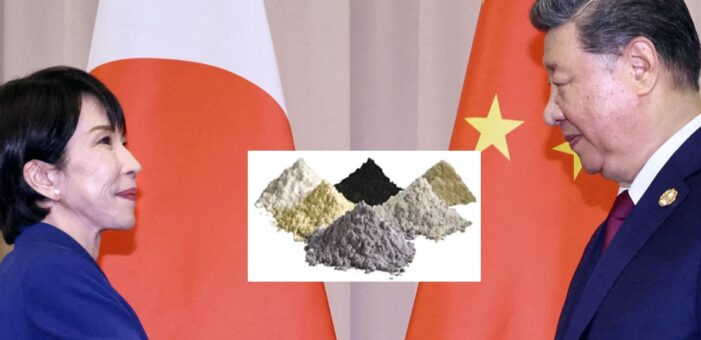
As China barred exports of so-called dual-use goods to Japan that could be applied to military ends, Japan has to urgently search for alternative sources and simultaneously explore its own rare-earth-rich mud from the deep seabed near the remote Minamitorishima Island, in a landmark experiment aimed at strengthening access to critical minerals amid growing geopolitical and supply-chain risks.
The test, led by the Japan Agency for Marine-Earth Science and Technology, will run from January 11 to February 14, about 1,900 km southeast of Tokyo. It will mark the first attempt to continuously lift seabed material from depths of around 6,000 metres using a fully integrated deep-sea mining system.
Researchers plan to assess whether the system can extract and transport roughly 350 metric tonnes of mud per day, while closely monitoring environmental impacts both on the ocean floor and aboard the research vessel. Officials said the trial is designed to validate technical feasibility rather than establish immediate commercial production.
The project comes as Japan and its Western allies seek to reduce dependence on China, which dominates global rare earth refining and processing and has tightened export controls on a range of strategic materials. Rare earths are critical for electric vehicles, wind turbines, electronics and defence technologies.
“One of our missions is to build a supply chain for domestically produced rare earths to ensure a stable supply of minerals essential to industry,” Shoichi Ishii, a programme director at Japan’s Strategic Innovation Promotion Program, told Nikkei Asia.
No Production targets for now
No production targets have been set, but if the trial is successful, the agency aims to conduct a larger-scale demonstration by February 2027 at similar daily recovery levels. Because processing cannot be carried out at sea, the extracted mud would be shipped to Minamitorishima, where seawater would be removed using centrifugal equipment, reducing volume by about 80%. The material would then be transported to mainland Japan for separation and refining.
The government-funded initiative has spent around 40 billion yen ($256 million) since 2018, Ishii said, though authorities have not disclosed estimates of recoverable reserves.
Ishii also said a Chinese naval fleet entered waters near Minamitorishima in June while a Japan research vessel was conducting seabed surveys within Japan’s exclusive economic zone. “We feel a strong sense of crisis that such intimidating actions were taken,” he said, underscoring the strategic sensitivities surrounding seabed resources.

Will Japan Rush To Test Deep-Sea Rare Earth Extraction Near Minami Torishima island? added by Sridhar P on
View all posts by Sridhar P →
Pingback: US Steps Up Efforts To Secure Rare Earths Supply Chains Outside China -
Pingback: China’s Rare Earth Monopoly Not Forever, Markets Decide: Experts - Rare Earths Watch