
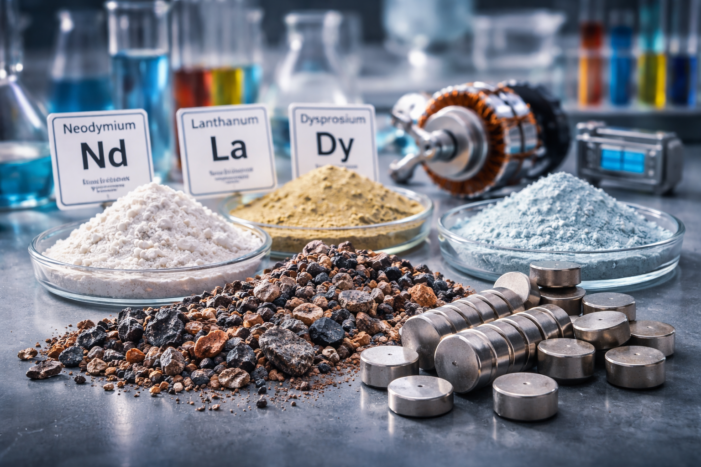

The global rare earth industry in 2025 entered a markedly different phase compared with a decade earlier, shaped by geopolitics, accelerating energy transition demand and sustained efforts to reduce dependence on China-dominated supply chains. What had once been a cyclical niche market increasingly took on strategic significance for governments and manufacturers alike.
China remained the central player, accounting for roughly 60–65% of global mine output and more than 85–90% of refining and separation capacity, according to estimates compiled from the U.S. Geological Survey and industry disclosures. While its share of raw mining declined modestly over the years, China’s grip on high-value processing ensured continued influence over pricing and downstream availability.
Prices for key magnet materials such as neodymium and praseodymium were firmer in 2025 than historical averages, supported by demand from electric vehicles, wind turbines, industrial automation and defence electronics. Although prices did not revisit the extreme spikes seen in earlier geopolitical shocks, volatility remained elevated as markets reacted quickly to export controls, diplomatic tensions and policy announcements.
Demand growth in 2025 was structurally stronger than in the past. Permanent magnets emerged as the dominant growth segment, driven by electric vehicle penetration and renewable energy installations. EV motors, power steering systems and wind turbine generators collectively absorbed a rising share of global rare earth output, while defence and aerospace demand gained prominence amid heightened security spending in multiple regions.
Outside China, supply diversification advanced but remained incomplete. Lynas Rare Earths Ltd expanded production and processing capacity, reinforcing its position as the largest integrated supplier outside China. New projects in the United States, Australia and parts of Africa progressed through development stages, though many still relied on Chinese-linked processing for certain steps.
Policy Intervention in 2025 Market
Policy intervention was a defining feature of the 2025 market. The United States, European Union, Japan and India implemented or expanded critical mineral strategies, combining subsidies, offtake agreements and strategic stockpiling. Recycling and urban mining gained momentum, but secondary supply remained a supplementary rather than dominant source of material.
Trade and geopolitics increasingly shaped sentiment. Export controls, particularly on dual-use technologies and rare earth-related products, introduced supply risks that were priced into markets. These dynamics reinforced the perception of rare earths as strategic assets rather than conventional commodities.
By the end of 2025, the rare earth industry stood at an inflection point. Demand visibility was strong, investment was rising, and supply chains were slowly diversifying. Yet structural concentration, long project lead times and geopolitical uncertainty ensured that tightness and volatility would remain defining characteristics of the market heading into the latter half of the decade.

Rare Earth Industry Review: Market Conditions In 2025 added by Sridhar P on
View all posts by Sridhar P →