
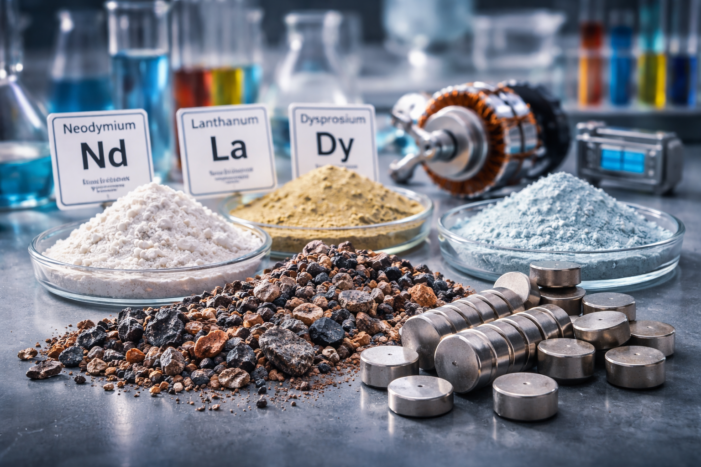
As U.S. policymakers weigh strategies to reduce dependence on Chinese rare-earth processing, Venezuela’s vast but poorly surveyed mineral belt has resurfaced in policy discussions as a possible alternative source. Yet experts and public data warn the reality is messy: geological potential exists, but proven rare-earth reserves and reliable valuations are scarce, making any quick U.S. pivot improbable.
Recent commentary in Washington and industry circles has suggested that access to Venezuelan critical minerals could help the United States and its allies diversify supply chains long dominated by China. Media and analyst notes following recent geopolitical developments pointed to Venezuela’s wider suite of critical minerals, including occasional references to rare earths in the Orinoco and Guiana Shield regions, as strategically attractive.
Where the deposits are said to lie
Public and private reports typically point to two broad Venezuelan geographies when discussing critical minerals:
• The Orinoco Mining Arc , a government-designated mineral zone in south-eastern Venezuela that the Venezuelan state has promoted for gold, nickel, bauxite and other minerals. Some local and regional media have asserted that the Orinoco area also contains rare-earth occurrences; one recent headline put a notional value on Venezuela’s rare-earth potential at roughly $200 billion. Those figures, however, are summaries of exploratory estimates and have not been corroborated by independent international audits.
• The Guiana Shield, the ancient geological block that underlies large parts of southern Venezuela and neighboring countries. The Shield is widely acknowledged to host a range of critical minerals, and informal reporting has flagged occurrences of coltan and rare-earth-bearing minerals in small, localized deposits. But these are patchy and often documented only in early-stage surveys.
Bold headline figures in some outlets, for example a recent widely circulated estimate valuing Venezuelan rare earths in the tens or hundreds of billions of dollars, draw on old or indirect surveys and on extrapolations from other commodities. Authoritative compilations such as U.S. Geological Survey publications and major industry trackers do not currently list Venezuela among the world’s leading, proven rare-earth reserve holders, and field-level data remain sparse. Independent analysts caution that asserted values are highly provisional.
Strategic, technical and political hurdles
Even if significant rare-earth concentrations exist, extracting and refining them at scale is not a short-term fix. Processing rare earths requires specialized separation and refining capacity, steps where China retains commanding market share, along with large capital outlays, skilled labour, stable regulation and environmental management. Venezuela’s mining sector has for years been hampered by underinvestment, weak infrastructure and governance challenges, all of which would complicate rapid development.
China already has deep economic ties with Caracas, centered historically on energy and loans. Beijing has been a major customer and investor in Venezuela’s oil sector, and Chinese firms have been involved across Venezuelan energy projects, a relationship that would complicate any U.S. effort to reorient mineral offtake. At the same time, U.S. officials and some industry voices have publicly floated the idea of seeking critical minerals from Latin America as part of a broader diversification strategy.
Venezuela’s geology includes areas where rare-earth elements could occur, and headline valuations have captured policymakers’ attention. But the balance of evidence suggests that, for now, Venezuela is a speculative, longer-term option rather than a ready alternative for U.S. efforts to counter China’s near-term dominance in rare-earth refining. Any U.S. strategy would require major, sustained investments in exploration, permitting, processing capacity and governance reforms, and would unfold over years, not months.

Can Washington Counter China With Venezuela’s Rare Earths? added by Sridhar P on
View all posts by Sridhar P →