
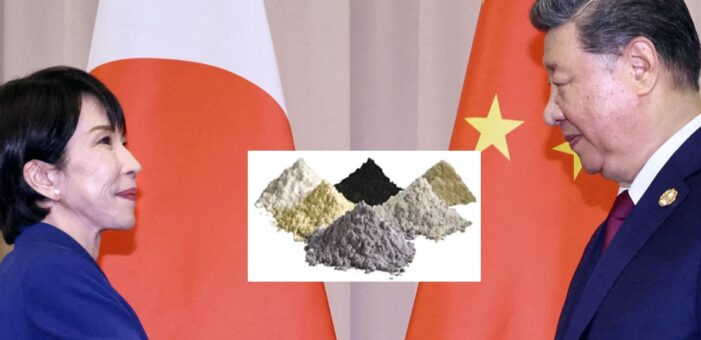
Japan sharply criticized Beijing on Wednesday after China imposed new restrictions on the export of dual-use items to Tokyo, branding the move “absolutely unacceptable and deeply regrettable” as tensions rise between the two economic powers. The dispute has drawn attention to a broader risk that China might extend controls to critical rare earth materials.
Dual-use items are products, software or technologies that have both civilian and military applications. Some rare earth elements fall into this category because they are vital in manufacturing advanced electronics, drones and defence systems.
The current row stems from comments made by Japanese Prime Minister Sanae Takaichi in late 2025, when she suggested that a Chinese military action against Taiwan could be seen as an existential threat to Japan. China views Taiwan as part of its territory, a position rejected by Taipei and opposed by Tokyo. Beijing demanded a withdrawal of Takaichi’s remarks, which she has so far refused to make.
In response, China’s commerce authorities announced on Tuesday that dual-use exports intended for military use in Japan would be banned with immediate effect. Tokyo’s government reacted swiftly, with Chief Cabinet Secretary Minoru Kihara condemning the measure at a midday press briefing. He described the action as a deviation from international norms and reiterated that Japan finds it unacceptable.
Kihara declined to specify which products would be affected, saying technical details were still being clarified. But the announcement triggered concern in Japanese markets. The Nikkei stock index reversed broader global gains and ended lower, with defence-related heavy industries among the laggards.
Rare Earths In Focus
Beyond the ban on dual-use goods, the spotlight has shifted to potential broader curbs on rare earth exports, which could have serious repercussions for Japan’s industrial base. China dominates global processing of rare earth minerals, and Japan still relies on the country for a significant portion of its supply, especially for heavy rare earths used in electric vehicle motors and other high-tech applications.
State-linked media in Beijing reported that authorities are considering tightening licensing requirements for rare earth shipments bound for Japan. Analysts warn such a step could disrupt key sectors of the Japanese economy, including automotive manufacturing and electronics, which depend on these specialized materials.
Economists have also weighed in: a short-term export halt similar to one seen in a 2010 dispute could dent Japan’s gross domestic product and inflict heavy costs on businesses that rely on uninterrupted supplies of these inputs.
Wider Diplomatic Strains
The export ban represents the latest in a series of retaliatory actions between Tokyo and Beijing over recent months. Beyond trade controls, both sides have lodged diplomatic protests, and China has previously enacted travel advisories and other measures in response to Japan’s stance on Taiwan.
However, Tokyo has not outlined any direct counter-measures. But officials have been monitoring industry reactions closely and have reiterated the importance of diversifying supply chains to reduce dependence on any single foreign source for critical materials.

Japan Calls China’s Rare Earths Export Ban ‘Unacceptable’ added by Sridhar P on
View all posts by Sridhar P →
Pingback: Will Japan Rush To Test Deep-Sea Rare Earth Extraction Near Minami Torishima island? -
Pingback: Rare Earths Market Outlook in 2026: Demand to Keep prices volatile - Rare Earths Watch